Landscapes have never been stable or nonviolent sites, and neither have the artistic traditions that capture them. The landscape genre—particularly in the US—has always been ideologically and politically charged. Though historical land surveys, maps, paintings, and photographs have adopted the pretense of neutrality, these forms have continually marked land as terra incognita, wasteland, or preordained property. Overlap Art Space’s current exhibition curated by Alicia Renadette, “Internalized Landscapes: I can feel this place in my bones,” resists the picturesque canon of the landscape genre. The work foregoes the idyllic visions captured by early American Hudson River renderings, the sublime monumentality of photography in the West, and instead offers tender, sentimental landscapes. Clothes caught in twisting brambles, gently swaying reeds, ripe fruit clutched in palms, and damp moss are just some of the images conjured in the Newport gallery. Rather than presenting pastoral scenery, the exhibition expands the landscape genre to critically center identity and lived experience. Here, “internalized landscapes” are sites where ecology, memory, migration, grief, exploitation, and intimacy continually shape one another.
The gallery space reflects Overlap’s curatorial interest in leveraging intersections between work. Though the space is split between a short central staircase, sightlines between the upper and lower levels allow for organic conversation across the airy space—works can be ordered and engaged with in myriad arrangements. Entering Overlap, visitors step into the gallery’s upper tier. To the left of this entryway, Michael Gunn’s and Maggie Nowinski’s works most immediately blur body and environment. Raised in rural Pennsylvania, Gunn paints remote sites as places of refuge for queer people lacking substantial community networks. Lovingly rendered, he captures moments of secluded, fantastical intimacy in nature. This work pulses with energy: Limbs radiate fluorescent red in What We Carry (2023), torsos bleed into surroundings in Night Travelers (2026), and Monologue’s (2025) central figure dissolves into patches of flourishing herbage. Adjacent, Nowinski’s ink and gouache “specimens” hybridize human and more-than-human bodies. In these black-and-white works, graphic musculoskeletal forms graft onto lush foliage, bulging fruit, and jumbled rhizomes. Nowinski, like Gunn, envisions radically queer, cyborg ecologies. Pairing titles charged with emotional turmoil (disbelief, rage, denial) with imagery capturing nature’s miraculous capacity for adaptation, resilience is at the heart of Nowinski’s richly layered work.
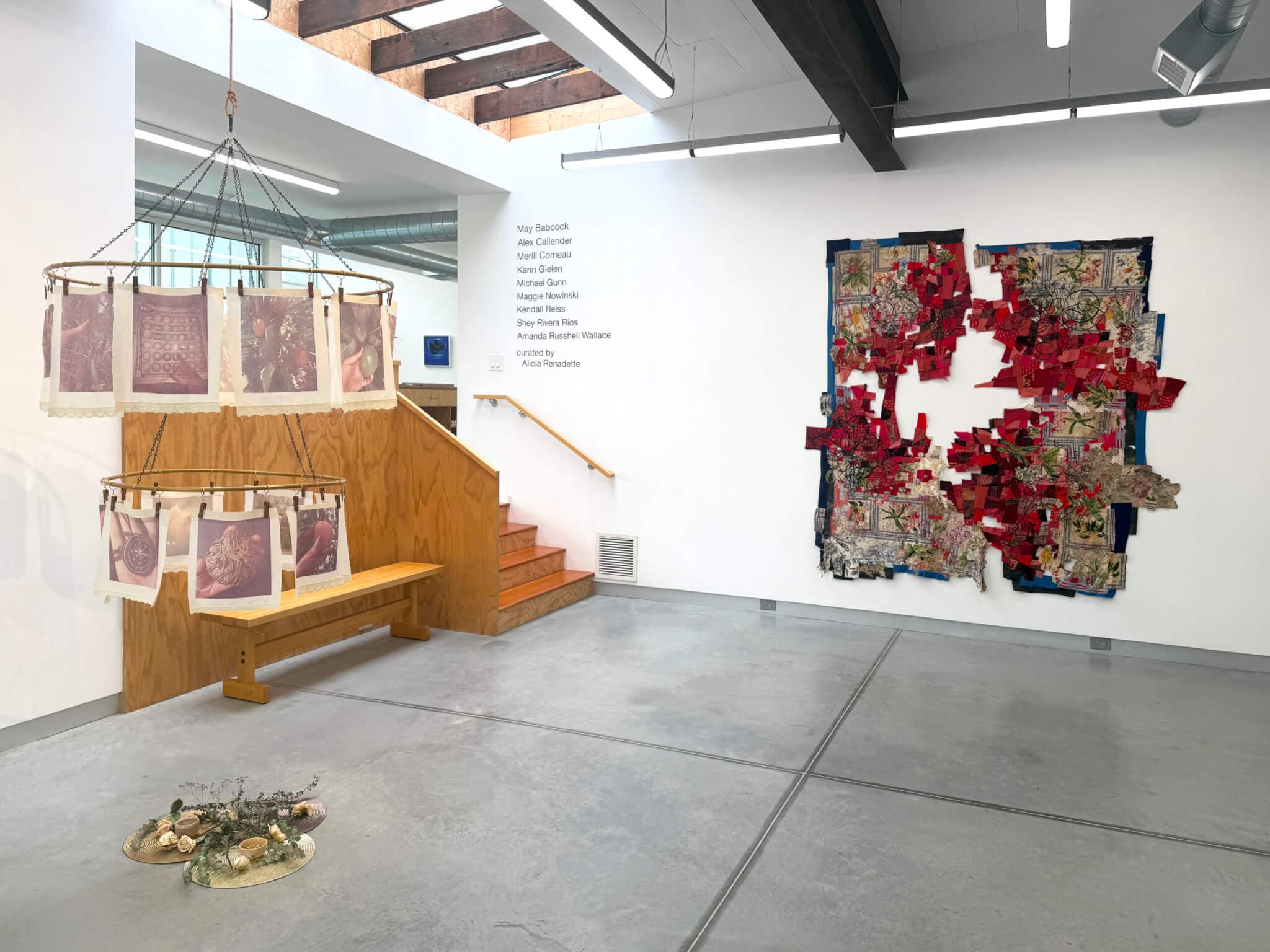
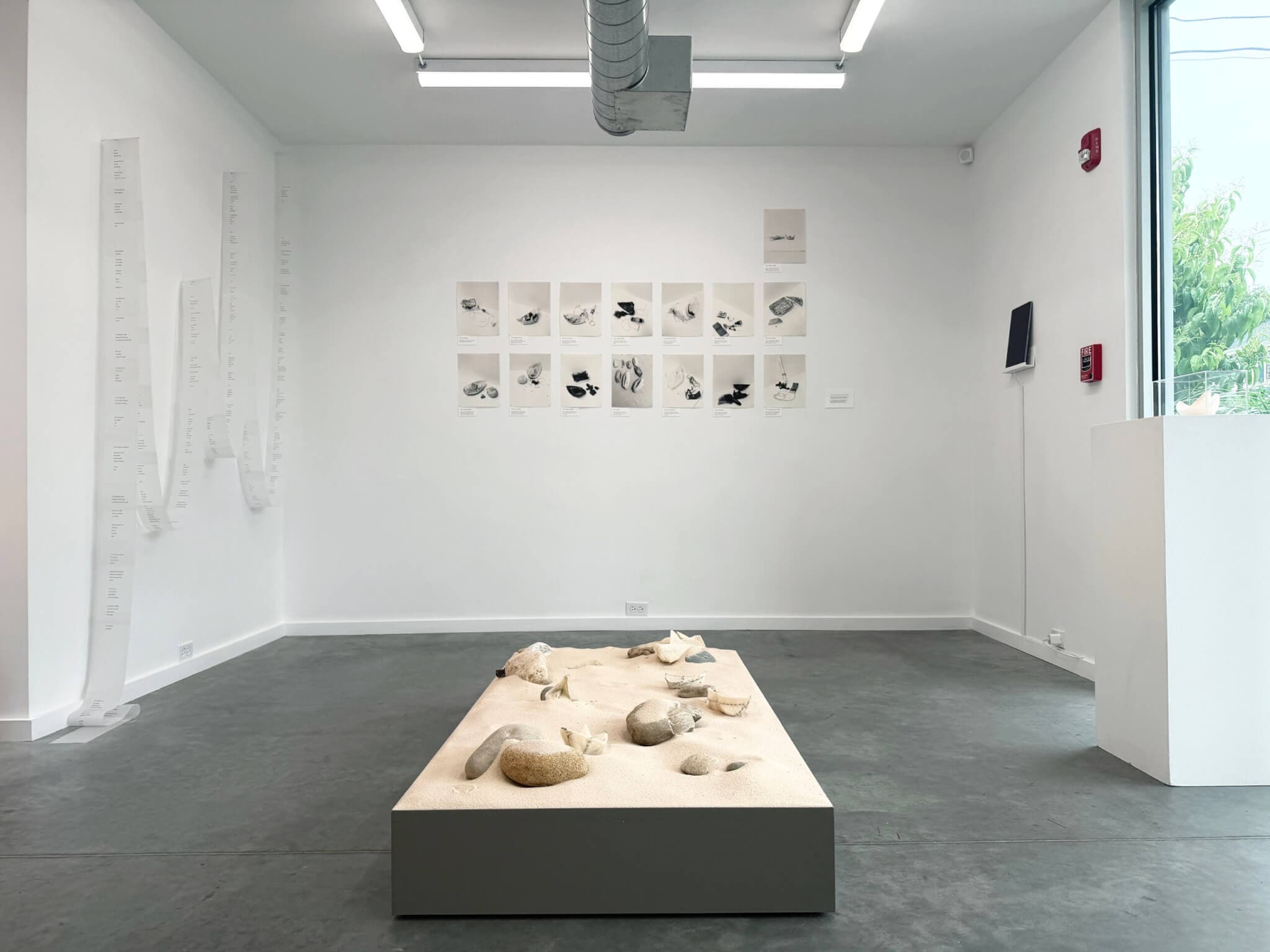
Installed at opposite ends of the gallery’s short staircase, Karin Gielen’s and Merill Comeau’s projects echo across distant geographies while maintaining emotional immediacy. On the floor at the top of the stairs, a series of paper boats is scattered in a sand-filled plinth along with stones, thread, and string. Gielen’s ongoing This Is Not a Boat ( series centers this fleet of small wax-coated paper boats, some folded from handwritten letters, others adorned with embroidery. Gielen, who immigrated to the United States from Belgium, conceived a series of predetermined actions to perform upon these figures during daily walks along the New England shoreline. Photos and video document her performances: boats are dragged through snow, lit like candles, weighed down by rock. These fragile vessels are charred, soaked, crumpled, and worn. In the gallery’s lower level, Comeau’s La Cadie Diaspora (2025) traces the serial expulsions and subsequent migrations of the artist’s Acadian ancestors. The work, an eight-foot-tall textile collage, is ruptured by a central gash. A patchwork of deep red bleeds from the void central to the work. Formally, this fractured quilt might be read as a map: landforms punctured by waterways, cut into by inlets. Paths spiral in black ink and hand embroidery across Comeau’s fabric landscape, tracking the Acadians’ long migration following the population’s violent extirpation in the mid-eighteenth century. Between Gielen’s fragile, childlike boats and Comeau’s delicate embroidery, narratives of migration play out along paths of memory.
Shey Rivera Ríos’s La tierra que me habita (the land that inhabits me) (2026) occupies the center of Overlap’s lower gallery. Crafted in the wake of the artist’s mother’s passing, La tierra captures a place and honors a loved one. Central to the work are images of Rivera Ríos’s family home and farm in Borikén (Puerto Rico). These photographs hang from the ceiling in a two-tier arrangement recalling a children’s mobile, lace curtains in a domestic interior, and clothes drifting in the breeze. Hands in these images—the artist’s and her mother’s—hold objects symbolically charged with life: a Rose of Jericho (the “resurrection fern”), seeds spilling from split fruit, heart-like plantain blossoms. An altar carefully arranged on the gallery floor offers eucalyptus, tobacco, rose, calendula, Florida Water. Beyond grief, this tender work captures renewal, abundance, vitality, a distant site’s capacity to revive memory. Nearby, Amanda Russhell Wallace’s Welling (1) and Welling (2) (both 2026), mourn alongside Ríos’s altar. In Wallace’s mixed-media collages, medical scans and images of the body are carefully assembled to echo aerial landscape photography, topography, and cross sections of the earth. Wallace traces family roots (and hereditary health concerns) to a Texas landscape pierced by oil rigs, where chemical exposure maps onto demographics of racial minorities and impoverished communities. This highly corporeal work makes legible the bodily imprint of environmental exploitation and chemical exposure. In dappled browns, body scans map out racialized terrain marked by degradation.
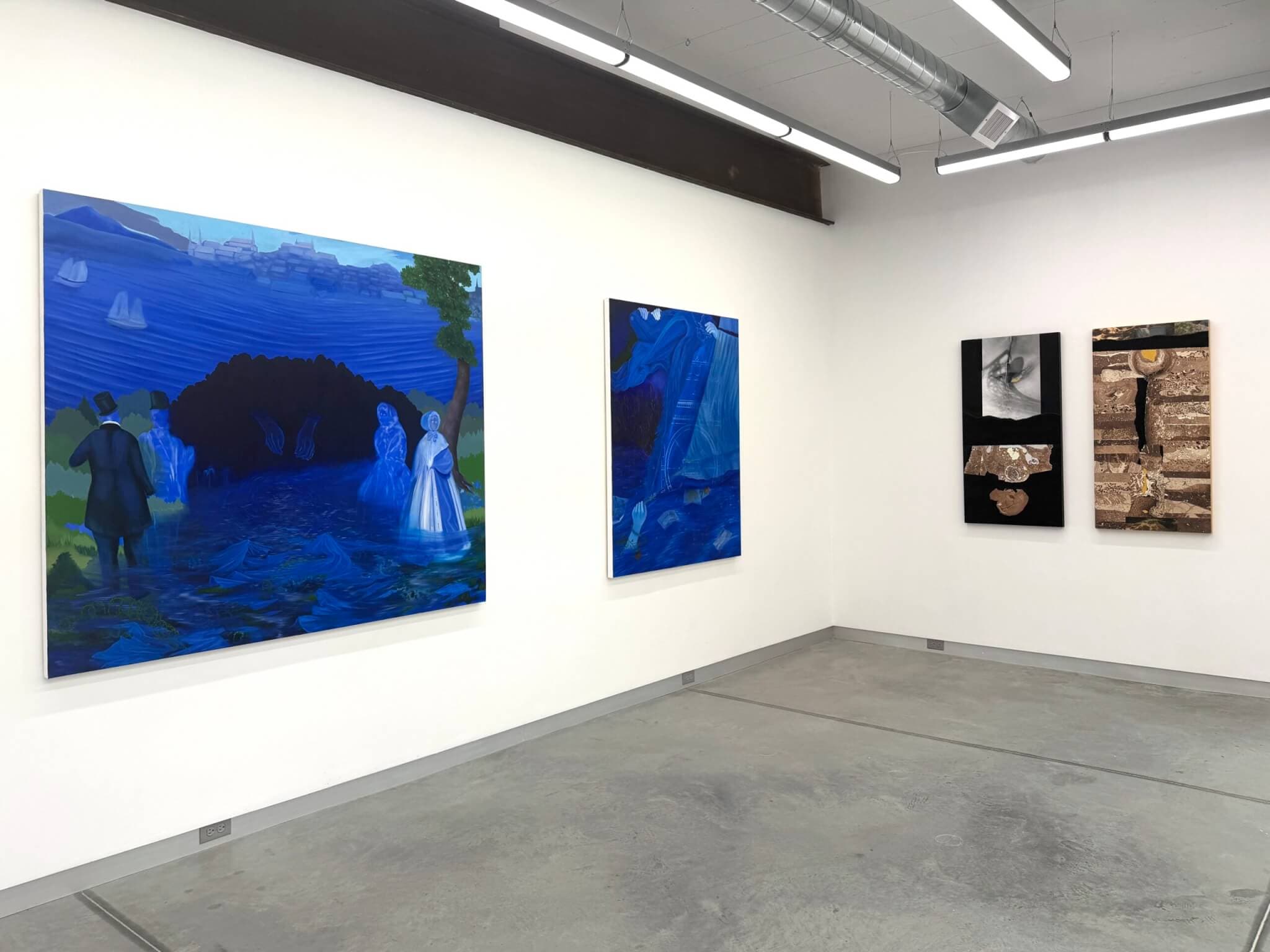
Several artists turn from inhabiting landscape to interrogating the visual and archival systems that have historically defined (and possessed) it. Herbaria—scientific collections of pressed plant specimens called “herbals”—have direct roots in the colonial extraction of economically viable species from colonized landscapes. At Overlap, multiple works reference the herbarium to discuss concepts of colonialism and displacement. May Babcock, a multiracial artist of Taiwanese Chinese descent, adopts the formal language of the herbarium in her Rhode Island Herbarium series (2018–). Here, seaweed specimens are harvested from New England waterways. These samples are integrated into Babcock’s papermaking process, embedding them directly into the richly textured paper which surrounds them. In shimmering gold text, Babcock’s seaweeds are labeled by the location from which they were sourced—sites marked by disturbance and contamination. Though these herbals speak to care, identity, and belonging, they still largely operate within the extractive framework of the herbarium. Alongside these specimens, Alex Callender’s large-scale oils flood the tools of colonial expansion in vivid blues. Antique maps, ledgers, floorplans, and herbals are captured in rippling floodwaters which inundate tableaus of the colonial Atlantic. Callender’s critical pastiche responds directly to the nineteenth-century French wallpaper Les Vues d’Amérique du Nord (The Views of North America), which centered racist depictions of Black and Indigenous populations. Callender subverts this decorative precedent to reveal the social realities of settler land management.
Walking back up the gallery steps, you might realize you missed Kendall Reiss’s Objects-for-the-End-of-the-World (2023–). This series, tucked around the corner from the gallery’s entrance, glitters in the light of Overlap’s south-facing windows. Objects include tablets, necklaces, and talismans crafted from glass, metal, and wood. Fragments of tulip and magnolia trees in the range of 100–400 years old are cast in glass, capturing their form in intricate detail. Having evolved some 400 million years ago, woody plants have witnessed and responded to geologic-scale shifts in climate. The circular motifs throughout the series, assembled from delicately curving seed pods and branches, recall the cyclical nature of forest succession and seasonality; the work operates at a distinctly nonhuman timescale. Reiss’s “necklace tablets” in particular evoke fossils or ancient relief sculpture. These works are relics and invite us to engage with more-than-human elders who offer a slower, deeper comprehension of time. Many key insights between the intersecting works featured in “Internalized Landscapes” emerge from retrospective excavation of political and personal histories, but this process of remembering and feeling also offers pathways to guide our future. Today, the “internalized landscapes” presented at Overlap may be felt more than known, but visualizing these sites makes new ecologies imaginable.
“Internalized Landscapes: I can feel this place in my bones” is on view through August 29, 2026, at Overlap Art Space, 112 Van Zandt Ave, Newport, RI.