Last week’s PolicyLink Summit, just outside Washington, DC, came at an eventful time. The same week CIA Chief John Ratcliffe was rebuffed by Putin on his visit to Moscow (where he asked Russia to not attack NATO allies) and devastating floods in Nepal killed more than 1,000 people (a number that is expected to climb), US District Judge Christopher Cooper heard arguments over the Trump administration’s threat to demolish the Kennedy Center and e-flux recirculated a 2010 Hito Steyerl essay, in which the artist asks, “What is the function of art within disaster capitalism?” The sixteen-year-old essay is as relevant today as it was in 2010.
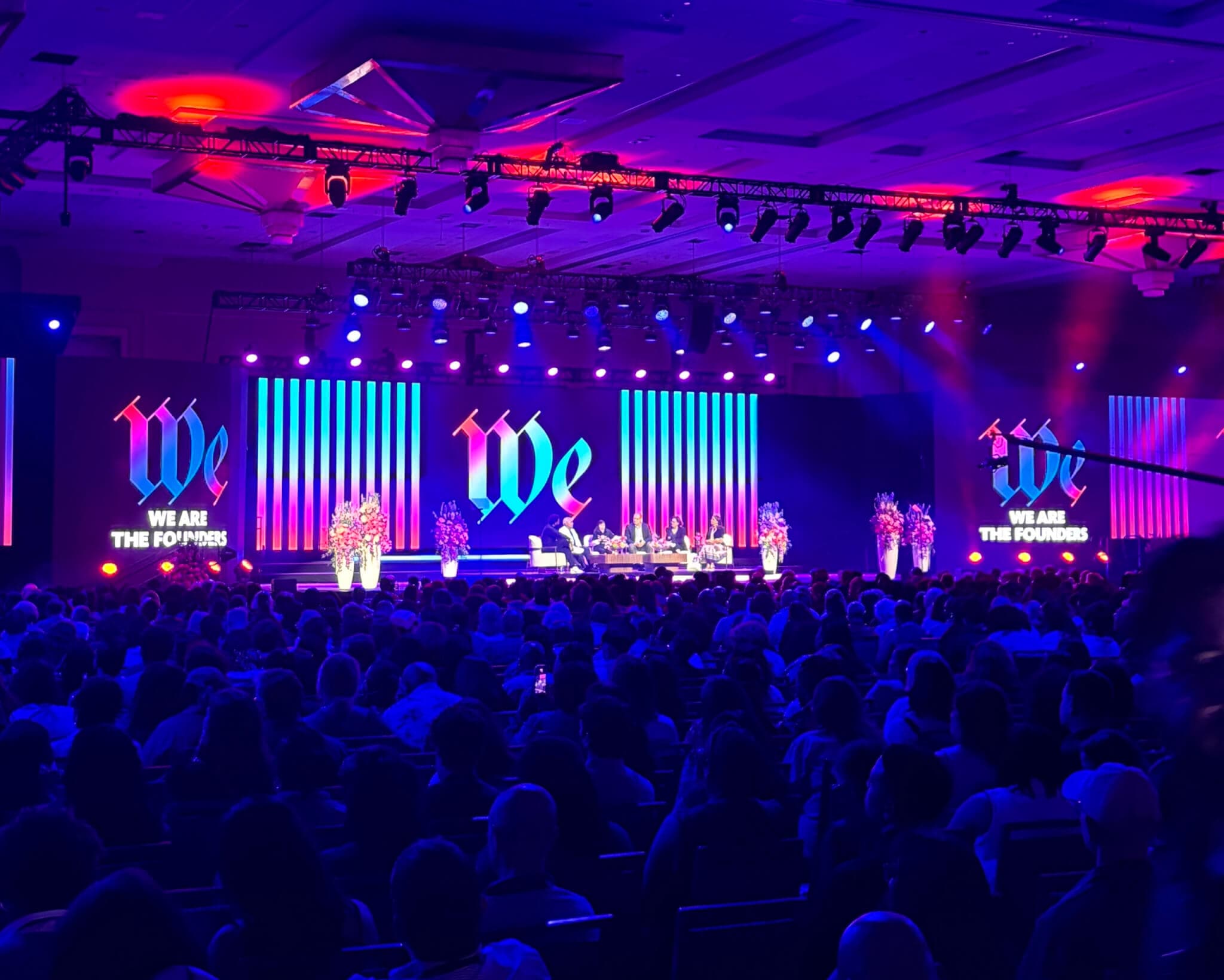
The PolicyLink Summit, titled We Are The Founders: Writing the Unfinished Story of Our Democracy, was organized by national research and social institute nonprofit PolicyLink.
The opening plenary, which appeared to have roughly a 5,000-person capacity, was a high-gloss banger of hype for a governing-for-all agenda and the 14th Amendment. Yet, the summit’s program seemed grounded in what felt like bringing an Obama-era-hope-and-change-politics knife to a second-term Trump-mass-deportation gunfight. What I mean by that is that the rah-rah of “in-this-house” progressivism in a room full of policy leaders, without articulating actionable deliverables, fails to meet this particular moment.
This year’s summit was unique in that it promised to convene arts and culture policy leaders in the US in what one attendee called the summit’s “first arts and culture caucus.” PolicyLink referred to the grouping of arts leaders as an “Arts and Culture Homebase for All.” Attendees included leaders from Americans for the Arts, the Center for Cultural Innovation, various state arts agencies, and the National Assembly of State Arts Agencies, along with artists, educators, and activist organizations such as Hands Off the Arts. Working groups, which formed organically at tables, were asked to “imagine five future states” broken down into “government that delivers, accountable institutions, democracy with real say, an economy built for shared prosperity, and communities that thrive.”
The working group sessions were short—roughly two hours—and the results were vague. Even though participants were professionals who have devoted their careers to the arts, the results consisted mostly of very broad statements: “Let’s imagine centering arts in government,” and “How do we use our power as creatives?” Compare this with fleshed-out policy agendas such as the Heritage Foundation’s Project 2025, which offers a thorough, granular, and shovel-ready policy. The contrast is stark. It points to the need for closed-door, sustained working sessions, but the question is who will lead them.
At the risk of sounding like a broken record, the lack of cabinet-level representation for culture in the US means there’s no single government entity responsible for setting national arts and culture policy. But it’s not just government that’s missing. Compared with other sectors, including agriculture, transport, education, and defense, the arts have no major for-profit actors. Just for fun, what would be the arts version of Boeing or Caterpillar? Sotheby’s and Gagosian? Any attempt at comparison breaks down fast.
Lacking both a government policy body and industry’s financial muscle, the arts sector is a one-legged stool dominated by nonprofits, academia, and the philanthropy that sustains them. This teetering structure also means the arts sector lacks a parallel system of revolving-door organizations, including think tanks, trade organizations, and lobbyist groups, to develop research, incubate policy, and cultivate pipelines of professional talent.
Perhaps the most valuable takeaway from the PolicyLink Summit was that it revealed, though didn’t acknowledge, a unique but underappreciated characteristic of the struggle the arts sector faces: how to design and implement policy in an institutional void.
Steyerl writes, “The production of art presents a mirror image of post-democratic forms of hypercapitalism that look set to become the dominant political post–Cold War paradigm.” Her text points to the bigger, more glaring issue the summit largely failed to address: taking stock of the institutions that make up US democracy today—and the possibility that we are likely in a new political era.
A few questions that might have been asked:
- Can democracy and big tech coexist?
- What can be done to halt the transition of power from states to corporations?
- What policies might be needed to sustain the arts and arts workers in a post-democratic society?
Structural readings are useful because they help illuminate the reasons for many of the material conditions the field faces. For example, a lack of government support and industry in the arts partially explains why wages remain so low: Without other sides of the aisle to cross over to, arts workers’ wage competition is with hobbyists and volunteers—the exploitation and free labor that Steyerl calls “the invisible dark matter that keeps the cultural sector going.”
Boston-based artist Jak Ritger picks up similar threads in a recent Punctr Art essay, arguing that the internet slang “locking-in” has shifted from describing a state of focus and productivity to a metaphor for systemic entrapment by platform tech and hyper-scaler rentier economies. If left unchecked, he posits, it will further evolve into a literal state of being locked into corporate walled gardens for basic goods and services, and even onto this planet by a permanent particle cloud of orbiting spaceships, satellites, objects, or trash.
The US District Court for the District of Columbia hearing regarding the Trump administration’s recent threats to demolish the Kennedy Center took place on the last day of the conference. I didn’t see any PolicyLink Summit attendees there, but Secretary of Commerce (and former president and CEO of financial services giant Cantor Fitzgerald) Howard Lutnick, whose wife, Allison Lutnick, was appointed to the Kennedy Center’s board by President Trump, attended.
The hearing marks the second time the court has been asked to stop the Kennedy Center from reinstalling President Trump’s name on the institution’s entrance, stemming from a federal lawsuit filed by Rep. Joyce Beatty last December. During the hearing, Judge Cooper questioned the board’s insistence on beginning the work to add Trump’s name to the facade by September 8. He observed that if the installation is set to occur within the next two weeks, the lettering must have already been purchased—and construction crews retained. If so, that procurement would violate appropriations law. Rep. Beatty’s lawyers cited Trump’s “mob-like” tactics and noted that adding Trump’s name to the building may have “irrevocably damaged” the center’s marble facade. The administration’s threat to demolish the center calls to mind how the “probably illegal” demolition of the East Wing has moved forward without congressional approval.
The hearing wrapped with the judge sending both sides to discovery. In a filing late that night, the Department of Justice said the Kennedy Center board’s resolution to either proceed with the renovation and install Trump’s name on the building or to demolish the building will “not be effectuated before October 8, 2026.” In May, Judge Cooper ruled that the board’s decision to rename the center as the Trump-Kennedy Center was illegal. This hearing, which addressed the administration’s determination to find ways around court orders, revealed how, under the present realpolitik in Washington, arts institutions are strong-armed into bending to the administration’s will, even if it starves them of funding. If the arts sector doesn’t move beyond post-its and dreaming to address the institutional and practical realities of how arts policy in the US is already changing, then we are, as Ritger warns, already locked in.