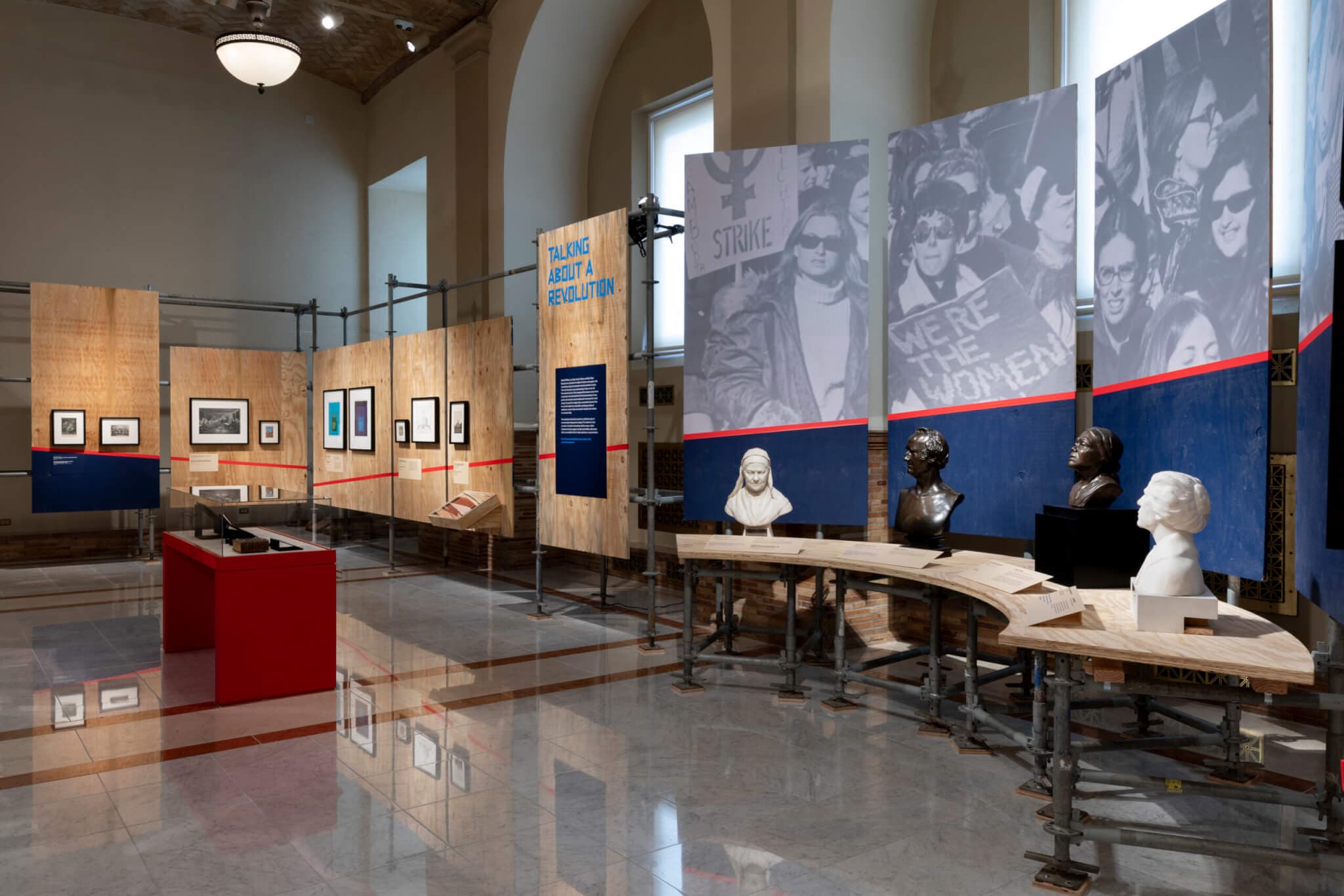
Step inside the McKim Exhibition Hall at the Boston Public Library, and you’ll see plywood panels among the stately columns and metal scaffolding climbing toward the vaulted ceiling. But this isn’t a construction site; it’s the setting for the library’s first major exhibition in nearly a decade. Makeshift masking-tape-style lettering spells out the title of “Revolution! 250 Years of Art & Activism in Boston,” and the show’s smart design drives home its central themes—the idea that the democratic project is unfinished and a more perfect union is possible, even if progress is always provisional (and, as we’ve seen recently, more easily dismantled than built upon).
The exhibition draws connections between past and present struggles by homing in on two questions: Who was left out of the Revolutionary War’s promise of freedom? And how are people working today to ensure this promise is kept? “Revolution!” explores these questions through more than one hundred artworks and archival finds from the library’s Special Collections, a trove of a quarter of a million rare books plus myriad other culturally significant materials made available to the public online and in person. There’s no shortage of wood engravings, bronze and marble busts, and painted portraits from centuries past, but contemporary art is key to the exhibition. It’s the first and last thing we see.
The show begins with something more potent and pointed than a land acknowledgment, greeting us at the entrance of the Exhibition Hall with Gregg Deal’s Indigenous Sign Initiative (2021). “ATTENTION: IF YOU CAN READ THIS YOU ARE ON INDIGENOUS LAND,” his stenciled letters say. Deal—a member of the Pyramid Lake Paiute Tribe and frontman for the band Dead Pioneers as well as a visual artist—is mimicking the familiar format of a street sign, but a slight blur on his bright-red lettering tells us it’s made with spray paint. There’s something delicious about the way Deal deploys an often less-than-licit medium to deliver a message with municipal matter-of-factness.
Deal’s piece also primes us for the impact of Providence-based photographer John Willis’s Throwing Tear Gas Back at Police, Backwater Bridge Stand-off (2016), an image that appears a few yards away in the exhibition’s first section, Making History. That section focuses on the stories we tell about the American Revolution but nonetheless feels like an apt home for this photograph, which is given the same pride of place as eighteenth-century mezzotints of Indigenous chiefs and Joseph-Siffrède Duplessis’s iconic 1778 portrait of Benjamin Franklin. Taken at a protest of the Dakota Access Pipeline that cuts through water sources and sacred sites of the Standing Rock Sioux Tribe, Willis’s photo captures a canister arcing through the air. Its trail of tear gas immediately registers as a rocket’s red glare against the dark sky, underscoring that fights for sovereignty continue in America today. And the image dovetails beautifully with a work that appears later in the show, Oglala Lakota artist Joe Pulliam’s TOKALA Defender of the water and earth (2020), a stunning spin on Plains ledger art that paints a protector figure with a headdress and a gas mask on an antique map of Dakota Territory.
Several vignettes in Making History explore Boston’s role as the birthplace of the Revolution. We see Paul Revere’s famed engraving of the Boston Massacre; wall text notes that when Revere hand-colored prints of this image, he often obscured the African and Indigenous heritage of Crispus Attucks, the formerly enslaved rope maker cited as the first American killed in the War of Independence. It’s paired with local artist Bob Tomolillo’s Boston Massacre Reboot (2020), a reworking of Revere’s composition that puts Attucks front and center, and Larry Rivers’s Some (Visual) After Thoughts on the Boston Massacre: Redcoats (Fold-Out) (1970), which aims ten muskets directly at the viewer in a menacing dispatch from the year National Guardsmen fired sixty-seven rounds at an anti-war protest at Kent State. Meanwhile, Edmund L. Mitchell’s photo Reenactment of Paul Revere’s Ride, Somerville, Massachusetts (1977) offers a little levity, showing a tricorn-hatted rider trotting past—wait for it—the Paul Revere Liquor Mart.
Another corner of this first section gathers glimpses of Faneuil Hall, dubbed the “Cradle of Liberty” for its role as a rallying point for the likes of Samuel Adams and John Hancock. A nineteenth-century engraving shows people rejoicing there at the close of the Revolution; James Wallace Black’s 1875 photograph has it festooned with flags for the Battle of Bunker Hill’s centennial. But two screenprints from Steve Locke’s Homage to the Auction Block (2022) offer a different view of the site, which stands steps away from where enslaved Africans and African Americans were sold at Merchants Row. In 2018, as an artist-in-residence with the City of Boston, Locke proposed creating an auction block memorial in front of Faneuil Hall, a building most Freedom Trail tourists likely fail to realize was financed by Peter Faneuil’s profits from human trafficking. Locke envisioned a bronze footprint of an auction block made from metal etched with Triangular Trade routes and heated year-round to 98.6 degrees, as warm to the touch as human skin. The memorial was never made, but Locke has returned to the auction block silhouette in this ongoing series, nesting it inside four squares in a nod to Josef Albers’s Homage to the Square. Albers’s color studies of straight-from-the-tube paint are icons of pure abstraction. Locke suggests there’s no such thing—that there’s no severing form from content, that the interplay of these cool blues and purples will not soothe us, that the auction block is the foundation America was built upon, as fundamental to its story as the square is to geometry.
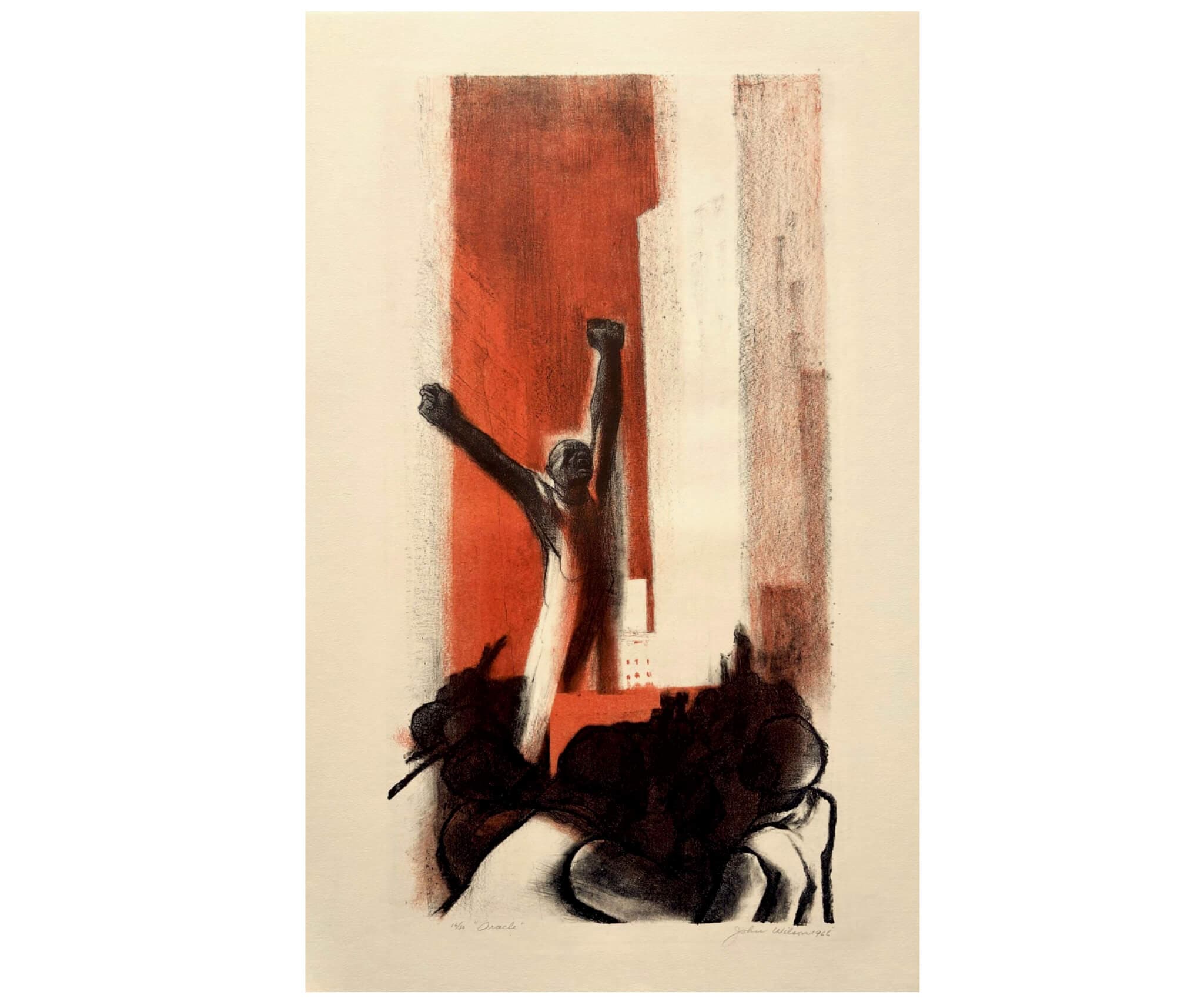
While I’m focusing on contemporary art in this review, I must mention the protest photography that’s a major highlight of the show’s middle sections. Many images are culled from the Boston Herald-Traveler Photo Morgue, estimated to contain as many as a million photos dating from 1906 to 1972, the year the newspaper shuttered. Some spotlight well-known events and figures. We see crowds on Essex Street during the 1912 Bread and Roses labor strike in Lawrence; we see Martin Luther King Jr. at the 1965 Freedom Rally on Boston Common. Other scenes may be less familiar. We see Mothers for Adequate Welfare demonstrating at the Grove Hall welfare office in Roxbury in 1967. A 1970 photo shows Russell Means, national director of the American Indian Movement, speaking in Plymouth on Thanksgiving 1970 for the first National Day of Mourning. Photos from 1971 capture cops in riot gear manhandling anti-war protesters at Government Center. Another photo from that year has jubilant activists pouring out of an abandoned Harvard building after the ten-day occupation that led to the creation of the Cambridge Women’s Center, now the country’s oldest continuously operating community center for women. Together, these images and others document liberatory movements that the exhibition frames as much a part of the Commonwealth’s revolutionary history as ye olde men with muskets. And they’re clustered close to Roxbury-born artist John Wilson’s 1966 lithograph Oracle, an avatar of activism created with a limited palette and a composition distilled to crystalline potency: a crowd suggested by a few strokes and shadows, a Black man rising from it, arms raised against the red sky and white skyscrapers.
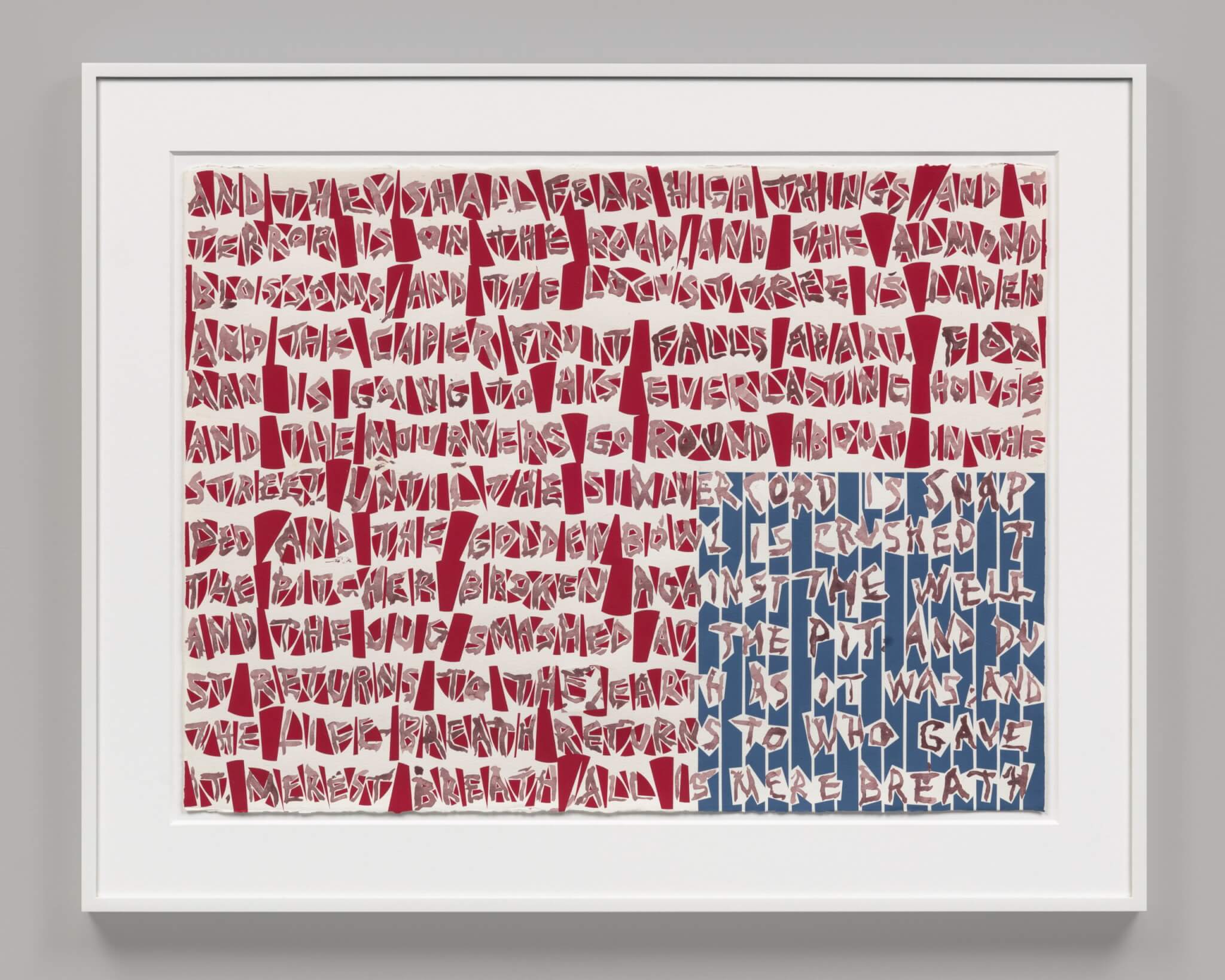
The exhibition’s final section, Another World Is Possible, features work by living artists, many of whom rework forms and materials of the past to engage with urgent concerns of the present. I’ll zero in on three of them here, starting with two Boston-based artists. Taylor Davis’s gouache and watercolor work And They Shall Fear (2024) presents the American flag upside down, as it was historically flown by ships in distress. She forms her stars and stripes from the words of Ecclesiastes 12, using ancient text to speak to contemporary experiences of families separated at the US-Mexico border. Without the wall text, I wouldn’t have known to make that connection, but it certainly feels like “terror is on the road” for many at the moment. Davis painstakingly painted these words with a three-foot-long dowel; reading them likewise demands slow and careful attention. Another wall showcases Caleb Cole’s poignant, poetic In Lieu of Flowers, an ongoing series memorializing trans people murdered in the US through anthotypes, a nineteenth-century form of photography made with photosensitive material from plants. Here we see four portraits, all made in 2024, of subjects killed in Massachusetts, among them Rita Hester, whose unsolved 1998 murder catalyzed the Transgender Day of Remembrance, and Jahaira DeAlto Balenciaga, an activist and aspiring social worker who helped found that day before she too was murdered in 2021. Cole creates these tender works with sunlight, roses from their garden, and the subjects’ own self-portraits. Time is another ingredient: The exposures require days or weeks of devotion, and like any bouquet, the delicate results fade over time.
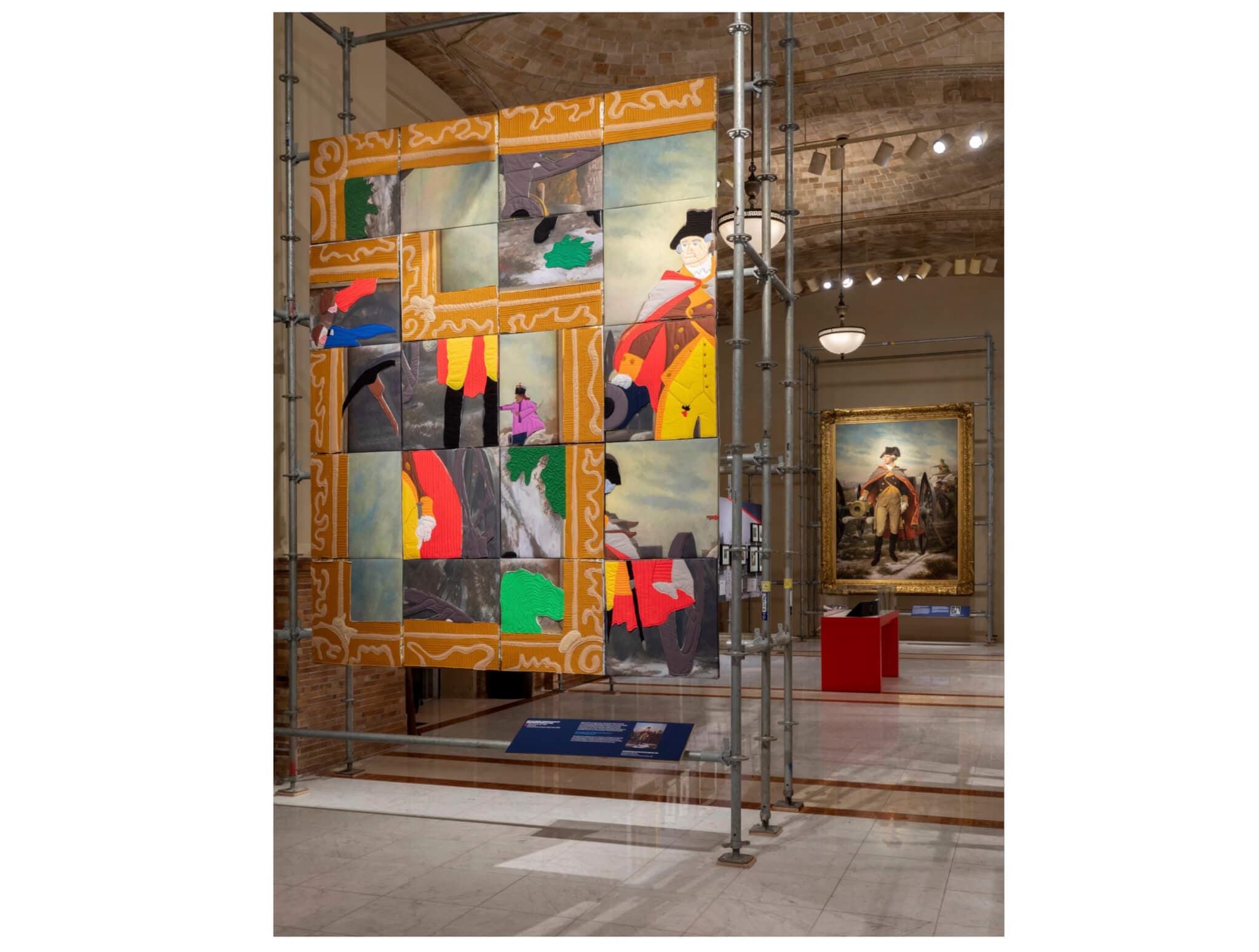
Michael Thorpe’s Out of Order, Fortification of Dorchester Heights (2025), commissioned for this exhibition, delivers its perfectly fitting final note. Thorpe’s quilt deconstructs and reassembles Emanuel Leutze’s 1852 oil painting Washington at Dorchester Heights, seen early in the show and normally hung behind the library’s reference desk. This massive painting depicts a turning point in the Revolutionary War, when General Washington’s amassing of cannons prompted British troops to evacuate Boston after a year-long siege. Purchased in 1955 with funds raised by Boston Public School students, it shows the founding father who enslaved more than three hundred people in a traditional heroic pose, his white-gloved hand resting on one of those cannons. It took a crew six hours to transport this ten-foot-tall behemoth across the library. Thorpe’s quilt, positioned so you can view both works simultaneously, offers quite a counterpoint. Drawing on traditions of expressive quilting developed by African American women like the quilters of Gee’s Bend, Alabama, it’s soft, lightweight, alive with bright color and squiggling stitches. And, crucially, it’s modular. Thorpe, who grew up in Newton and moved to New York in 2020, has returned to the library multiple times over the course of the show to rearrange the square panels. It’s a work always in progress, and it feels completely congruent with the exhibition’s design and themes.
The library’s collections, too, are unfinished. BPL lead curator of the arts Kristin Parker, who curated “Revolution!” in concert with Emily Bibb, Eve Griffin, Caitlin Julia Rubin, Aaron Schmidt, and Calder Sell, noted that some of the anti-ICE protesters who demonstrated in Copley Square on January 30 entered the library to warm up from the cold and view the show. Some even donated their handmade protest signs to the art collection—a reminder, one of many in this timely exhibition, that the story of America’s revolutions is ongoing.
“Revolution! 250 Years of Art & Activism in Boston” is on view through April. 21, 2206, at the BPL’s Central Library, 700 Boylston Street, Boston, MA.