This article originally appeared in Issue 16, published May 16, 2026. You can read this piece and more by purchasing a copy of or subscription to the magazine.
It was March 2025 when my colleagues Michelle Millar Fisher, Rachael Arauz, and I visited the Saunderstown Weaving School in Rhode Island. We drove from Providence, passing leafless trees and gravel driveways before turning onto a small road. At its end stood a modest wooden house with a barn and silo. From the outside, it gave very little away.
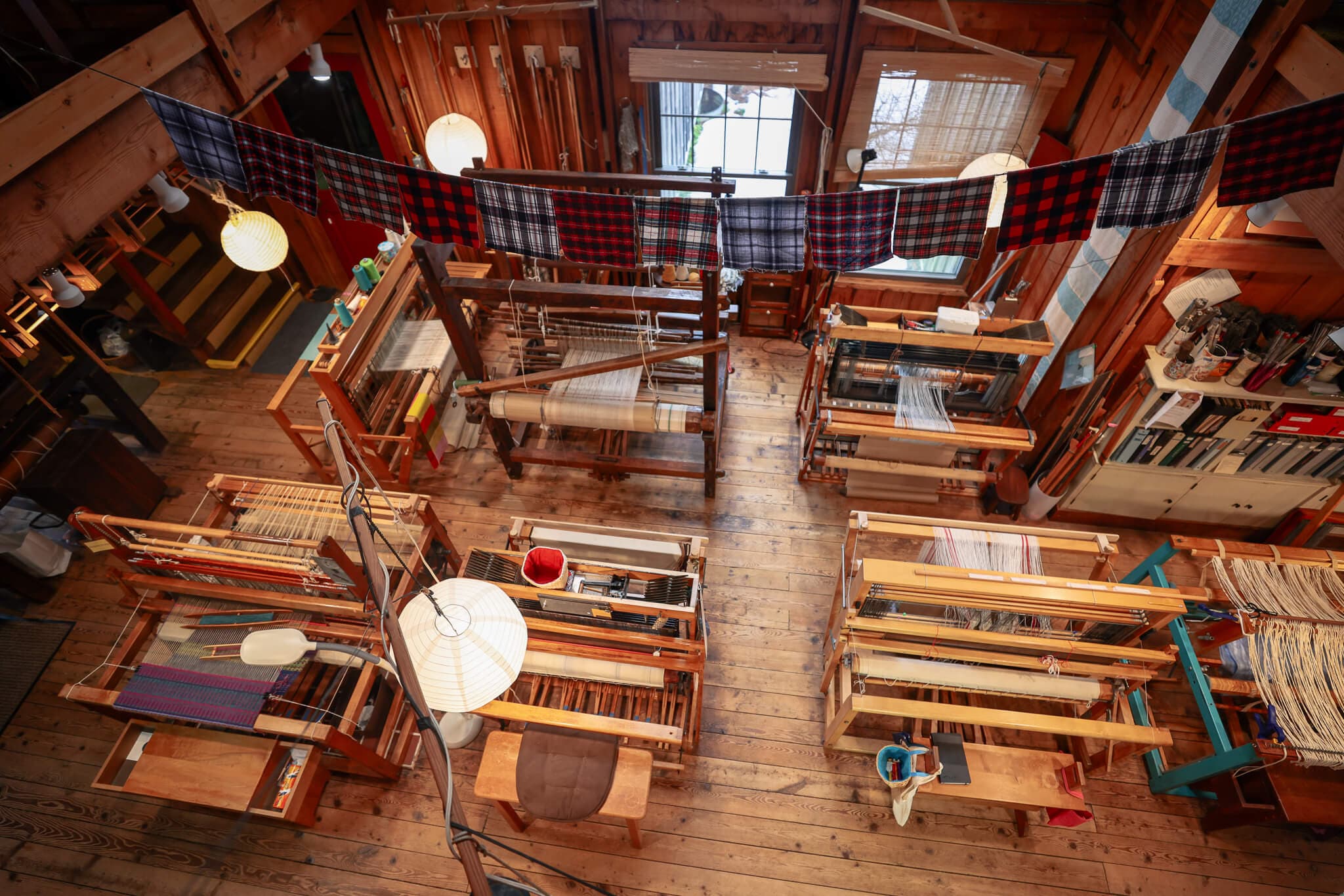
Once we stepped inside, the space opened into something unexpected. Soft daylight filtered through the windows, filling rooms packed with looms. Narrow paths opened between them, and my body adjusted as I moved through—slowing, turning sideways. Threads stretched and hung in varying states of tension and completion, catching the light as it shifted across the room. The interior was dense and warm, carrying the faint scent of wood and fiber, charged with a quiet, continuous energy. What the exterior withheld, the inside offered in full.
Norma Smayda is the guiding force behind the Saunderstown Weaving School. She founded the school in 1974, with encouragement and support from Andrew Staley, who later became her second husband, and she has sustained it for more than five decades. My colleagues and I first heard about it while researching craft schools across New England for a potential exhibition project. By then, all three of us had visited many craft schools, each shaped by distinct institutional histories and regional contexts. It is not uncommon to discover craft schools in these scenic New England villages. Visiting them often involves a kind of pilgrimage by car—leaving the city behind and following winding roads until a wooden building emerges from the landscape. But Saunderstown registers differently. There is no sign marking its presence, no architectural gesture distinguishing it from its surroundings. With Smayda’s living quarters taking up the rear of the house, it exists instead within a domestic space, where teaching courses through the rhythms of everyday life.
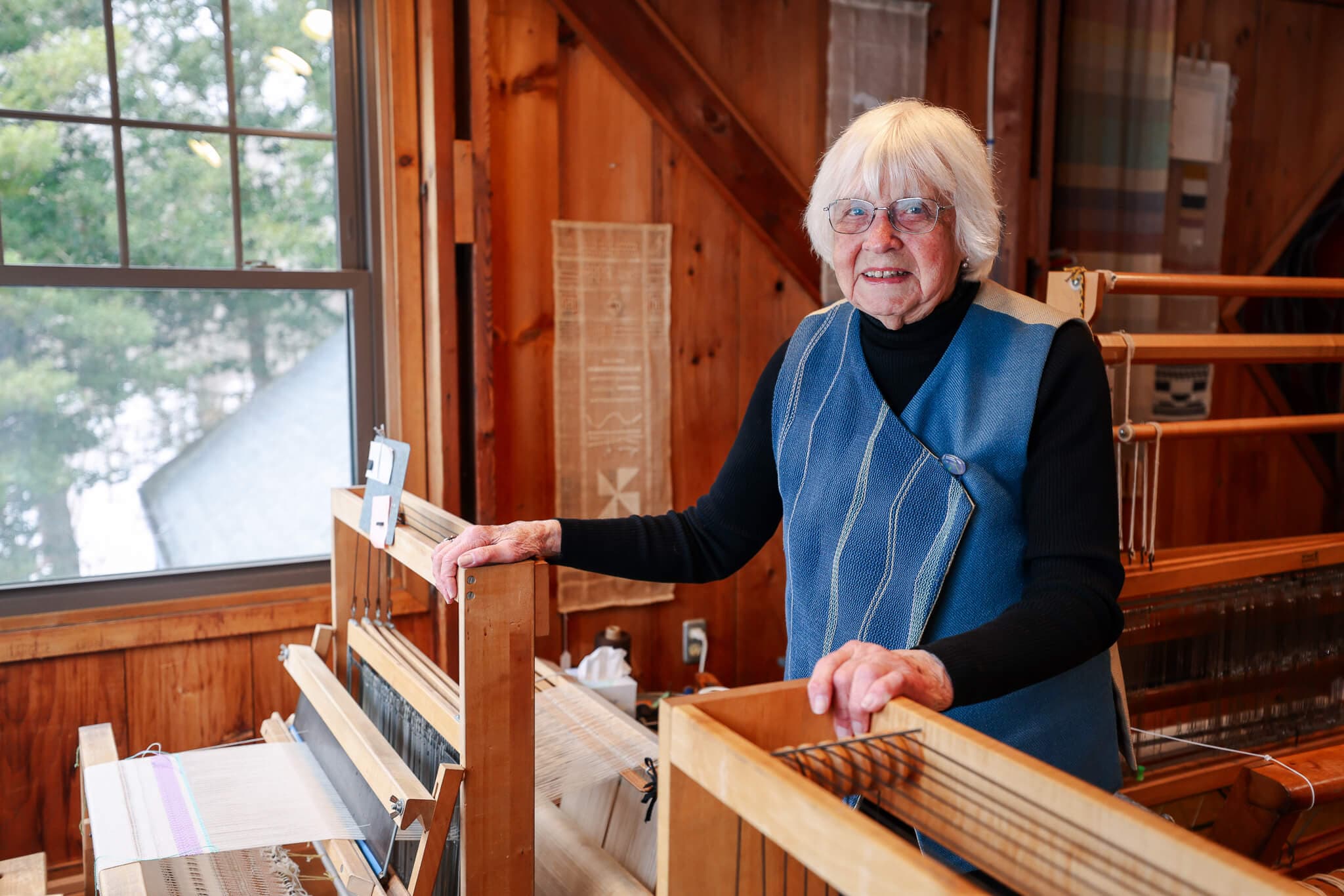
Norma Smayda at the Saunderstown Weaving School. Photo by Carlie Febo for Boston Art Review.
Long before the school took form in Rhode Island, its pedagogical foundations were laid in Norway, where Smayda first encountered weaving. It was taught in husflidsskole—home craft schools—established after World War II in every major county, teaching weaving and other domestic crafts as living cultural practices. It was within this tradition that Smayda’s lifelong relationship to weaving would eventually take root. Yet her path to the loom was neither immediate nor predetermined.
Born in New Jersey and raised in Pennsylvania, Smayda studied biology, trained to observe and pay attention to detail—a habit that would later shape how she understood the loom and weave structures and how she taught others to approach the craft. Her first extended stay in Norway began in 1956 during her first husband’s Fulbright fellowship; upon return, they came to live in Saunderstown. Weaving remained peripheral to her then, present in the surrounding culture but not yet something she practiced herself.
It was not until a later return to Norway in 1967 that she enrolled in her first weaving course at Monica Skolen, a small weaving school housed in an old wooden cabin in Frogner Park, behind the royal palace in Oslo. There, she began to work at the loom daily, learning traditional Norwegian techniques and developing a sustained relationship to its structure and rhythms. When she returned again in 1973, she enrolled in a year-long program at Bærum Husflidsforening, one of the home craft schools on the outskirts of Oslo. She studied intensively, six hours a day, five days a week, within an environment where weaving was taught as part of a continuous material language extending through spinning, dyeing, and structural design. Her mentor, Ulla Hansson, taught with the understanding that Smayda would carry this knowledge—not only how to weave, but how to teach—elsewhere.
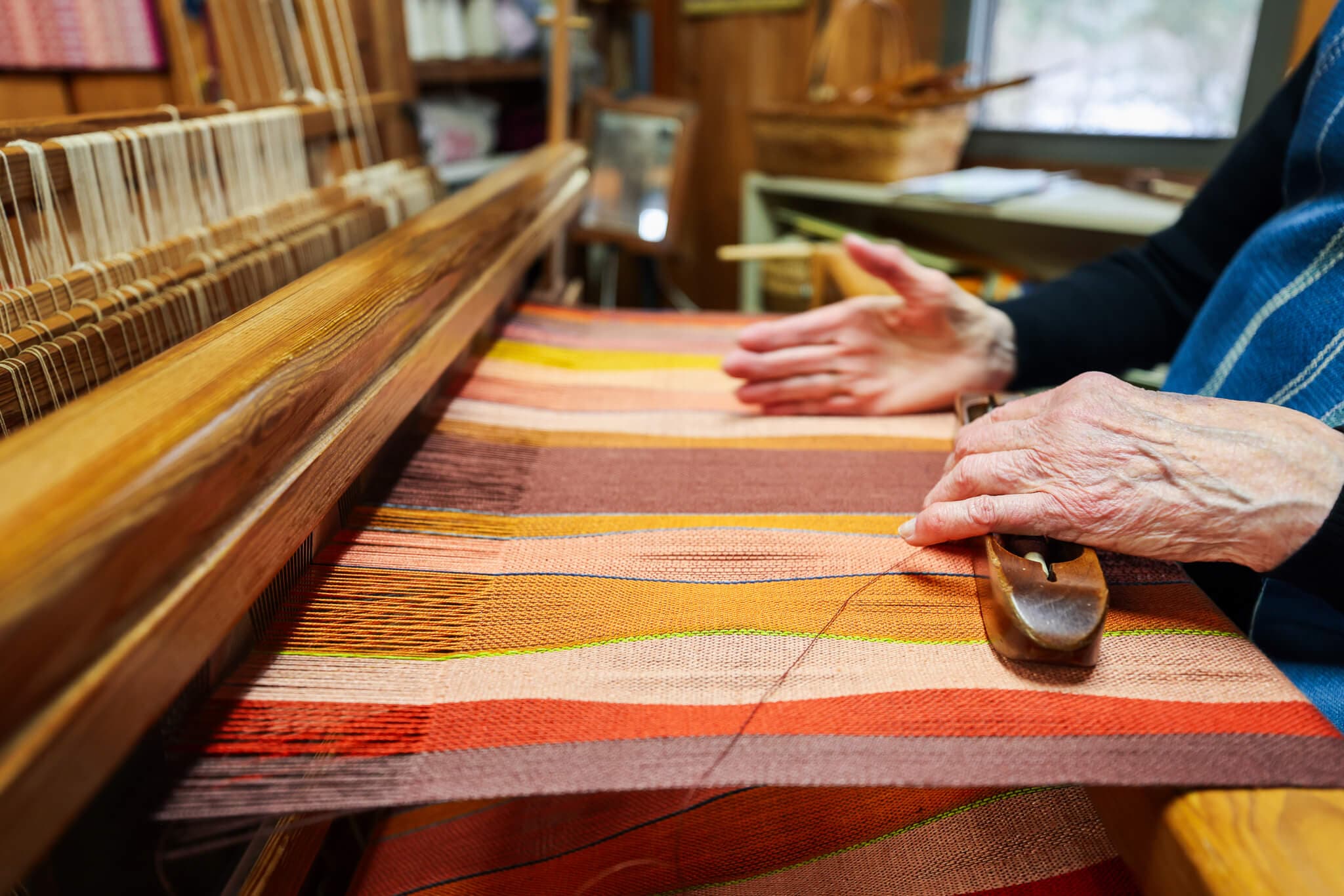
Norma Smayda at the Saunderstown Weaving School. Photo by Carlie Febo for Boston Art Review.
When Smayda returned to Saunderstown in the fall of 1974, there was no studio waiting for her. Knowing with certainty that she wanted to instruct others, she began with a small group of students and the support of a local craft organization, though they had no space of their own. An advertisement was placed in the local newspaper, asking whether anyone might have unused looms or room to spare. The response came from neighbors who offered Smayda use of a craft room beside their home.
At first, there were only a few looms purchased by Smayda and Staley, or brought from Sweden, along with several small looms that students carried with them to class. Each loom remained in place once it arrived, becoming a fixed point for instruction. Students returned to the same loom week after week, learning not through demonstration alone, but through sustained contact with the structure of each unique piece of equipment. The school took shape not by institutional design, but by the ongoing relationship between teaching and use. Only years later would Smayda come to live there herself. What began as a borrowed room gradually became home and the center of her life’s work.
Today, the school holds forty-nine looms, each one extending its capacity to sustain teaching. Several of them carry histories that extend beyond the school itself. One belonged to a weaver trained at the Bauhaus who brought it with her when she fled Germany before World War II and later settled in Massachusetts, carrying with it a pedagogical lineage from a period when weaving was being redefined as a site of modern artistic inquiry. Smayda often reflects on this continuity. “I love the thought that Anni Albers and Paul Klee may have used or touched this very loom,” she said, noting that Albers taught weaving and Klee introduced mathematical concepts to the weavers at the time. Situated nearby, another loom built by Rhode Island handweaver William Henry Harrison Rose in the late nineteenth century reflects an earlier generation of regional craft practice. These looms function not as relics, but as working structures, remaining in daily use and holding within their frames the accumulated knowledge.
Built of wood and metal, the loom itself is a crafted object that demands ongoing care. Over the past decade, Jeff Mee, who first arrived as a student twelve years ago and has remained ever since, has gradually assumed responsibility for maintaining and repairing the school’s looms. He came to Saunderstown after a friend described it as “a nationally renowned weaving institution.” His entry into loom maintenance was unplanned: Smayda learned of his woodworking background and asked him to look at a malfunctioning loom; the repair was simple to him. He has since worked in close dialogue with Smayda. “I couldn’t do most of the repairs without Norma being there,” he explained, “because she knows how all those looms are supposed to work.” It is a division of labor that keeps the looms—and the school—running.
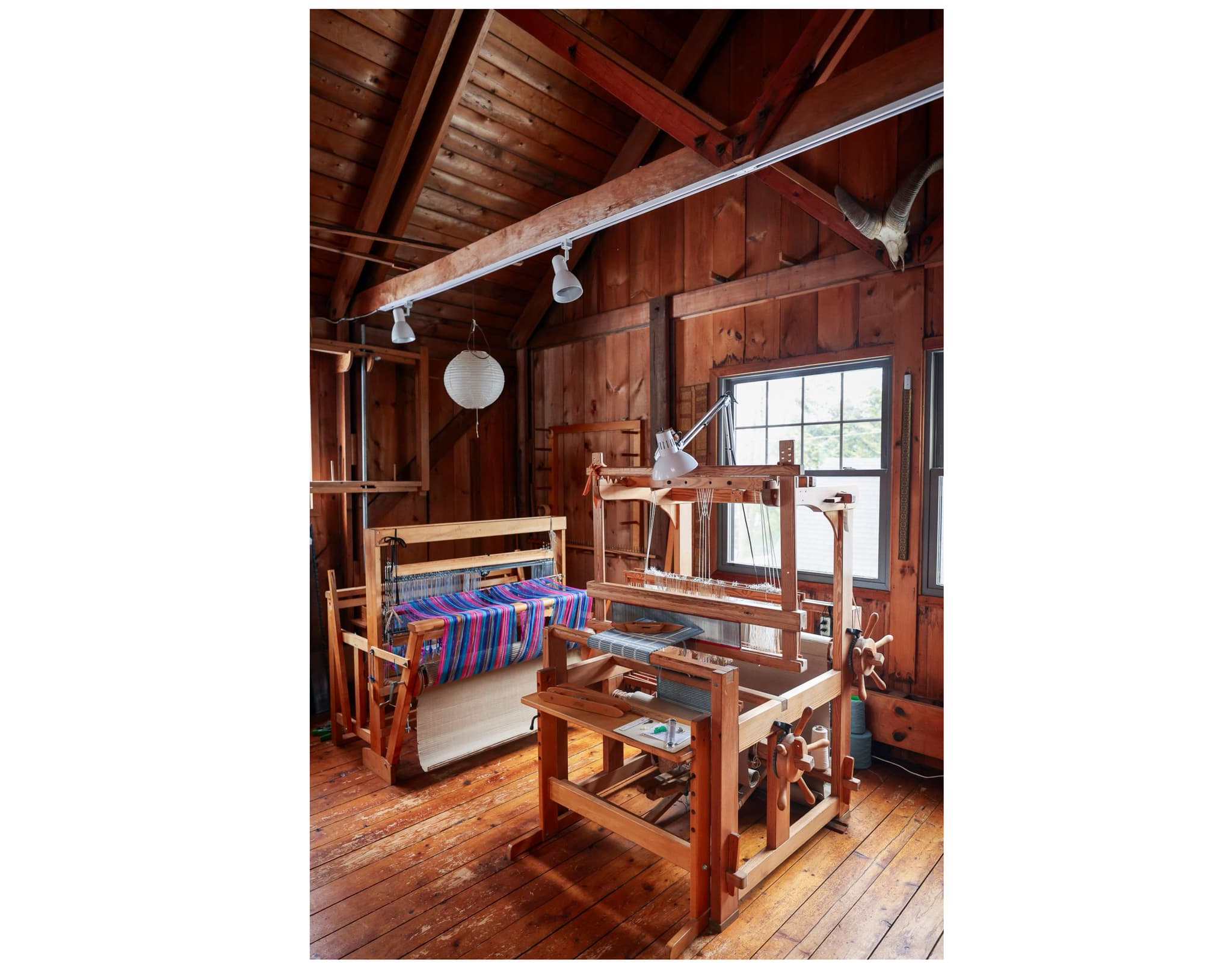
Looms used at the Saunderstown Weaving School in Saunderstown, Rhode Island. Photo by Carlie Febo for Boston Art Review.
Mee’s experience reflects the school’s broader pedagogical ethos. As he describes it, Smayda allows students to “learn at whatever speed you want and as much as you want”—an approach she arrived at through deliberate rejection of the alternative. After founding the school, she pursued an MFA in visual design at the University of Massachusetts Dartmouth, wondering whether institutional teaching might offer stability and legitimacy. Instead, she found that standardized curricula and required attendance worked against meaningful learning. What the university offered was an imposed structure; what weaving required was sustained, self-directed attention. At Saunderstown, Smayda began to build a school around those contrasts.
Although she initially imagined university courses like Weaving 101 or 102, she discovered that her mostly adult students arrived with their own intentions. Echoing the Norwegian husflidsskole, the school encourages independent yet collaborative work within a shared space rather than synchronized progression through prescribed coursework. Classes remain small—eight to ten students meeting weekly in three-hour sessions across a fifteen-week semester—with tuition kept deliberately accessible, only a few hundred dollars per semester, to ensure access beyond institutional or financial privilege.
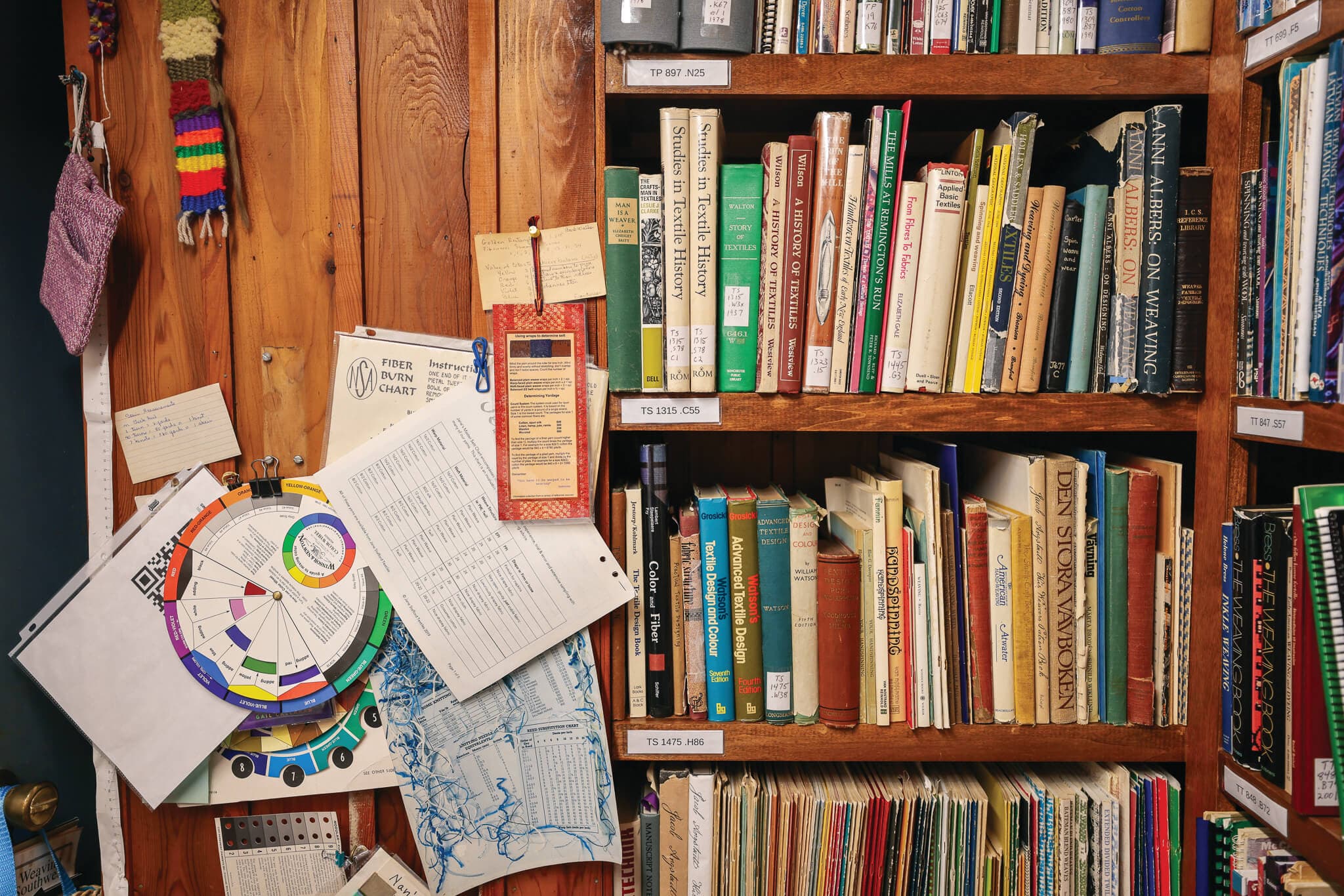
Some of the library’s more than 2,300 books. Photo by Carlie Febo for Boston Art Review.
Tucked beside the kitchen, beyond the looms, is a small room that serves as the school’s library. It began not as a formal archive, but as a gradual accumulation. Over time, former weavers, aging out of their practice or nearing the end of their lives, entrusted her with their own collections. Books arrived quietly, passed from one weaver to another, joining a lineage already in progress. The library now holds more than 2,300 books, along with weaving journals and binders filled with samples, notes, and fragments of cloth. Only recently has the collection been formally catalogued, with the help of a retired librarian who came to the school during a public tour and immediately recognized what had taken shape. The library has now been fully archived in the Library of Congress, with a searchable catalog record created. Yet long before it was systematized, its scope lived in Smayda herself. Jaimee Veronneau Roberts, who came to the school with a background in fashion design from the Fashion Institute of Technology, put it simply: “She’s like a weaving encyclopedia.” The shelves do not merely store accumulated volumes; students move between the loom and book, consulting draft structures and patterns as an ongoing conversation.
Also housed within the library are binders from Cross Country Weavers, a national exchange project connecting handweavers across the United States since 1958. Each year, thirty participants respond to a shared theme and distribute handwoven samples to every other member, creating a decentralized archive that exists across homes, studios, and schools rather than in any single institution. Invited to join the group in 1988, Smayda has contributed and received hundreds of swatches, which now form part of Saunderstown’s working collection.
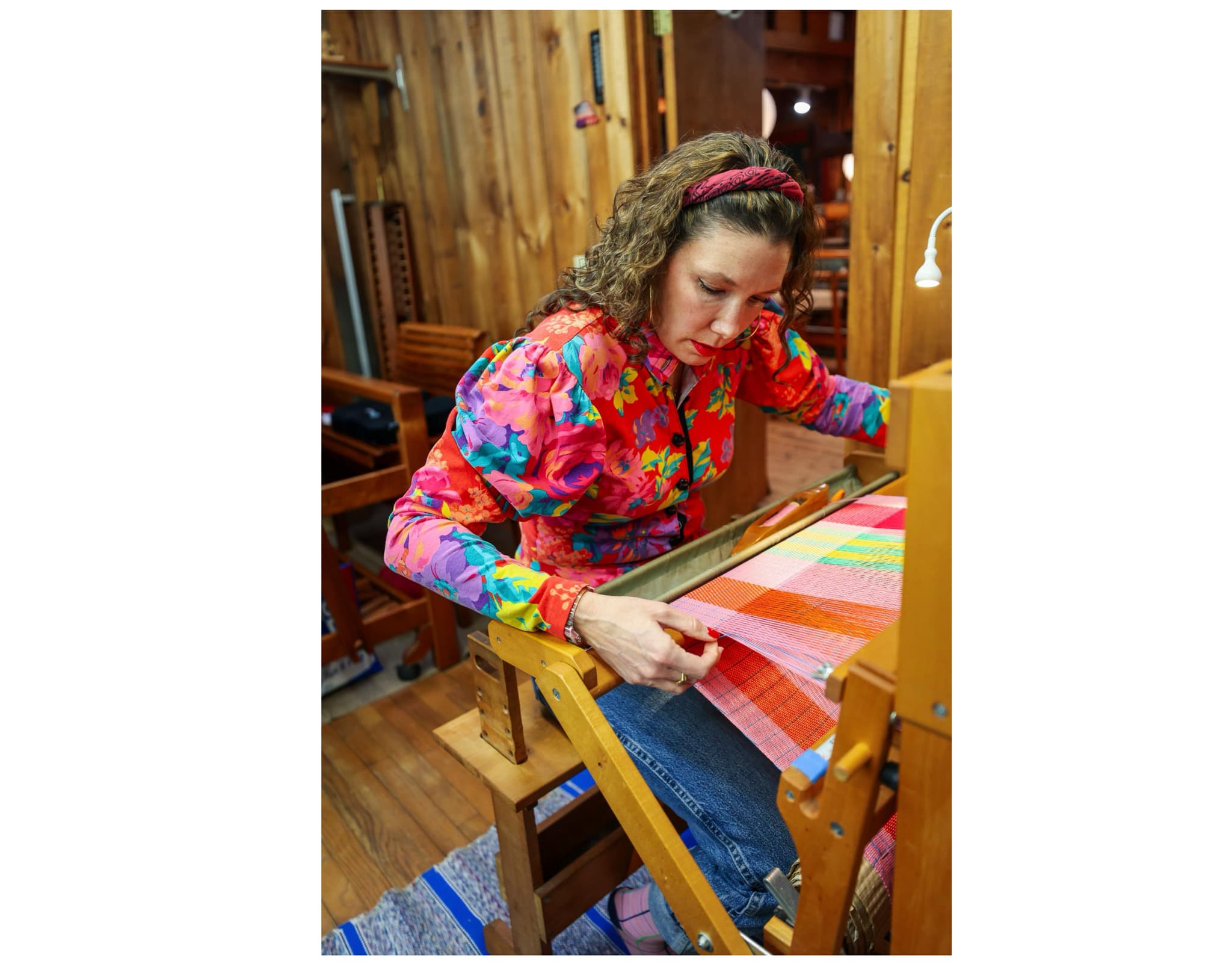
Textile artist Jamie Veronneau Roberts working at a loom. Photo by Carlie Febo for Boston Art Review.
The school’s influence has never been contained by its walls. As Elizabeth Hill, who also first arrived as a student and now assists with teaching and the library, noted, “Weavers across the country have heard of her.” That reputation has been built through decades of national workshops on Weaver Rose, Scandinavian techniques, and the fan reed, introducing historical structures to generations of weavers. Yet recognition alone does not account for her impact. “Norma is always moving forward,” Hill remarked, describing a restlessness that drives her continued research and experimentation. That inquiry has found its way into journals and into two books—Weaving Designs by Bertha Gray Hayes (2009) and Ondulé Textiles: Weaving Contours with a Fan Reed (2017)—formalizing knowledge long transmitted through practice and making it available to weavers who may never visit the school itself.
When asked what keeps them committed—and what allows Saunderstown to endure—the students consistently returned to Smayda herself. After twelve years of study, Hill observed, “I’ve never seen anybody like her who has such a wealth of knowledge.” Yet endurance rests not on expertise alone. As Mee noted, “part of it is camaraderie… learning from each other,” describing the shared labor of the classroom. For Roberts, the bond extends beyond instruction: “She’s not only a teacher—she’s a friend and a mentor.” The school endures because it has never been only a school.
At the end of the first visit, I asked what would happen if one day she were no longer here. Smayda paused, then said, “I don’t know.” The response lingered in the room. It was an honest answer to a question with no clear solution. The looms could be dispersed, the library archived, the space itself preserved—but these would be gestures toward continuity, not continuity itself. What Smayda has sustained here depends on presence: her accumulated knowledge, her daily attention, her willingness to meet each student where they are.
Around us, the looms stood in quiet readiness, threads suspended between beginning and completion. Books remained open where hands had left them. Nothing in the room suggested an ending. That the school has endured for fifty years is itself a form of knowledge. Pedagogies like this—intimate, domestic, resistant to institutional scale—do not transfer easily, which raises questions worth sitting with: what structures of archiving and infrastructure might support them, and how continuity can be built not just through preservation but through ongoing practice and care. Somewhere beyond this school, her students are weaving—teaching structures learned here, adapting them, carrying them forward into other spaces and lives. “All this brings me such pleasure and pride,” Smayda said. “I see it as very valuable in keeping the craft alive.” The work is alive, and so the conversations around it are only beginning.